
排序

SyEic_L Lv4

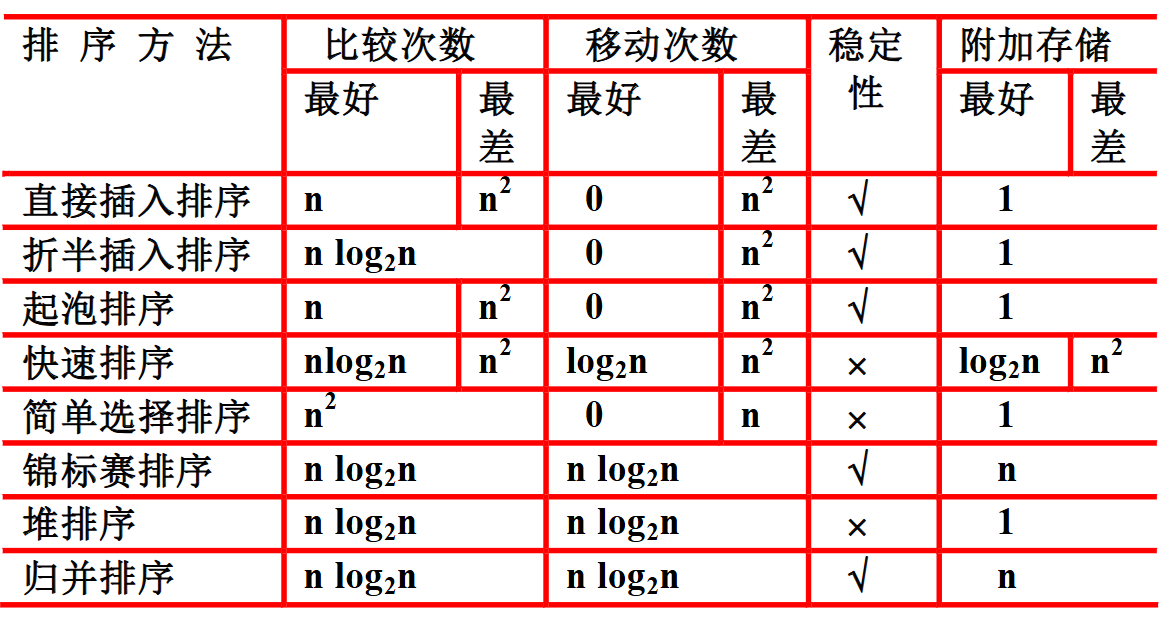
排序比较

插入排序

  • 直接插入排序
  • 折半插入排序
  • 链表插入排序
  • 希尔排序

直接插入排序

插入第ii个对象时,前面的i1i-1个已经排好序,按顺序从前到后比较,找到插入位置插入,原来位置上的对象向后顺移

1
2
3
4
5
6
7
8
9
10
11
12
13
14
15
16
17
18
19
template <class Type> void dataList <Type> :: InsertSort ( ) {
//按排序码 Key 非递减顺序对表进行排序
Element<Type> temp; int i, j;
for ( i = 1; i < CurrentSize; i++ ) {
if ( Vector[i] < Vector[i-1] {
temp = Vector[i];
for ( j = i; j > 0; j-- ){ //从后向前顺序比较
if ( temp < Vector[j-1] ){
Vector[j] = Vector[j-1];
}
else {
break;
}
}
Vector[j] = temp;
}
}
}

  • 时间复杂度:O(n2)O(n^2)

  • 有稳定性

折半插入排序

在插入时用折半搜索寻找插入位置

1
2
3
4
5
6
7
8
9
10
11
12
13
14
15
16
17
18
19
template <class Type> void dataList<Type> :: BineryInsSort ( ) {
Element<Type> temp; int Left, Right;
for ( int i = 1; i < CurrentSize; i++) {
Left = 0; Right = i-1; temp = Vector[i];
while ( Left <= Right ) {
int middle = ( Left + Right )/2;
if ( temp < Vector[middle] ){
Right = middle - 1;
}
else{
Left = middle + 1;
}
}
for ( int k = i-1; k >= Left; k-- ){
Vector[k+1] = Vector[k];
}
Vector[Left] = temp;
}
}
  • 比直接插入排序快
  • 比较次数与初始序列无关,仅依赖于对象个数
  • 有稳定性
  • O(nlogn)O(nlogn)

链表插入排序

数据存储在链表中

希尔排序(Shell Sort)

先分成若干组,在每一个组内用直接排序,然后再对整个序列进行直接插入排序

采用间隔分组方法分组

1
2
3
4
5
6
7
8
9
10
11
12
13
14
15
16
17
18
19
template <class Type> void dataList<Type> :: ShellSort ( ) {
Element<Type> temp;
int gap = CurrentSize / 2; //gap是子序列间隔
while ( gap != 0 ) { //循环,直到gap为零
for ( int i = gap; i < CurrentSize; i++) {
temp = Vector[i]; //直接插入排序
for ( int j = i; j >= gap; j -= gap ){
if ( temp < Vector[j-gap] ){
Vector[j] = Vector[j-gap];
}
else {
break;
}
}
Vector[j] = temp;
}
gap = ( int ) ( gap / 2 );
}
}
  • 不稳定
  • 最坏情况:O(n2)O(n^2)

交换排序

两两比较,如果逆序则交换

冒泡排序

  • 有稳定性
  • O(n2)O(n^2)

快速排序

任取序列中的某个对象,作为基准,左侧放小的,右侧放大的,对两个子序列重复施行

1
2
3
4
5
6
7
8
9
10
11
12
13
14
template <class Type> int dataList<Type> :: Partition (const int low, const int high){
int pivotpos = low; //基准位置
Element<Type> pivot = Vector[low];
for ( int i = low+1; i <= high; i++ ){
if ( Vector[i] < pivot ) {
pivotpos++;
if ( pivotpos != i ){
Swap ( Vector[pivotpos], Vector[i] );
}
}
} //小于基准对象的交换到区间的左侧去
Swap ( Vector[low], Vector[pivotpos] );
return pivotpos;
}
  • 平均情况:O(nlogn)O(nlogn)
  • 空间复杂度:O(logn)O(logn)
  • 不稳定

选择排序

  • 直接选择
  • 锦标赛
  • 堆排序

直接选择排序

  • 在一组对象v[i]v[n1]v[i] - v[n-1]中选择最小的对象

  • 若它不是第一个,则与第一个交换

  • 从这组对象中剔除这个最小的对象,在剩下的v[i+1]v[n1]v[i+1] - v[n-1]中重复执行上述步骤

  • 不稳定

锦标赛

  • 两两比较,选优胜者,循环往复,得到最小的对象,同时记录比较过程

  • 每个节点DataNode:data | index | active

    1
    2
    3
    4
    5
    6
    template <class Type> class DataNode{
    public:
    Type data; //数据
    int index; //节点在满二叉树的顺序号
    int active; //参选标志:1参选、0不参选
    }
  • 时间复杂度:O(nlogn)O(nlogn)

  • 空间复杂度:

    • 至少:2n12n-1
    • 最多:22k12*2^k-1
  • 稳定

堆排序

  • 最大堆

  • 堆顶和最后一个交换

  • 对前n1n-1个对象,filterDown

  • 重复执行

  • 时间复杂度:O(nlogn)O(nlogn)

  • 空间复杂度:O(1)O(1)

  • 不稳定

归并排序

  • 两个或两个以上的有序表合并成一个新的有序表
两路归并
  • n个对象,两两归并,得到n2\lceil \frac{n}{2} \rceil个长度为2的归并项
  • 两两归并,重复得到有序
  • 时间复杂度:O(nlogn)O(nlogn)
  • 空间复杂度:O(n)O(n)
  • 稳定

基数排序

  • Title: 排序
  • Author: SyEic_L
  • Created at : 2026-03-12 17:42:25
  • Updated at : 2026-04-11 10:54:48
  • Link: https://blog.syeicl.vip/2026/03/12/排序/
  • License: This work is licensed under CC BY-NC-SA 4.0.

Comments